


14th April -
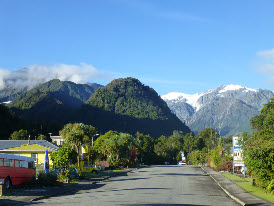 We experience all types of weather on the journey to Franz Josef and it was raining
hard with low cloud when we get there. We also pick up another hitch hike, a young
German girl who was working on a local farm mostly milking cows. She had been food
shopping which with hitch hiking takes all day.
We experience all types of weather on the journey to Franz Josef and it was raining
hard with low cloud when we get there. We also pick up another hitch hike, a young
German girl who was working on a local farm mostly milking cows. She had been food
shopping which with hitch hiking takes all day.
Despite our expectations we wake up to a clear and sunny sky and we can see the glacier
from our backpackers hostel/motel (free veg soup every night!). We've booked an 'Ice
Experience' tour which involves flying to the glacier in a helicopter, strapping
on your crampons, and then spending a few hours having a guided tour of the glacier.
As you can imagine it’s cold on the glacier but the clothes we have been given keep
everyone warm. John, our guide, a glaciologist (that’s handy) from Bournemouth is
already on the glacier wearing shorts and a t-
16th April -
After leaving Franz Josef we stop off for a photo of the Fox Glacier and decide that our glacier is far superior. The drive over the Haast Pass to Queenstown is spectacular and after a while we decide that there must be no more stopping for photos or we’ll never get there.
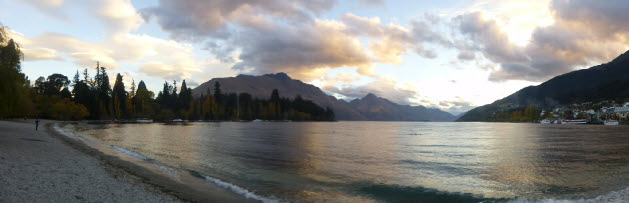
Queenstown has a Skyline Gondola like the one in Rotorua except this one is a lot
steeper. We want to go on the zipwires down the hill and save money by walking up
the hill rather than going in the gondolas -
On the way from Queenstown we stop at a small place called Arrowtown, an old gold mining town. A walk takes us to a panoramic view of the town from a nearby hill. Back in town the Arrowtown Autumn Festival (don’t pretend you haven’t heard of it) is in full swing and there are life size straw effigies (of local celebrities?) all over over the place.
19th April -
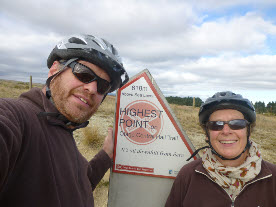
 We have decided to ride the Central Otago Rail Trail, 150km of disused railway track
normally completed in three days, we opt to do the most scenic 90km in two. We spend
the night before the ride at the small town of Clyde at the inland end of the trail.
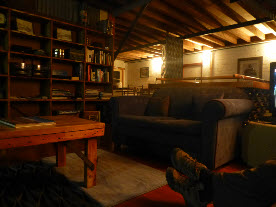
Our accommodation is called The Workshops and is a large garage, complete with inspection
pit, that has been converted into a B&B. There was no one around when we got there
but it seems common not to lock things up here and there was a note telling us to
let ourselves in.
We have decided to ride the Central Otago Rail Trail, 150km of disused railway track
normally completed in three days, we opt to do the most scenic 90km in two. We spend
the night before the ride at the small town of Clyde at the inland end of the trail.
Our accommodation is called The Workshops and is a large garage, complete with inspection
pit, that has been converted into a B&B. There was no one around when we got there
but it seems common not to lock things up here and there was a note telling us to
let ourselves in.
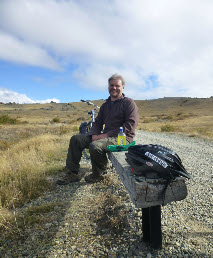 The rail trail is very well organised -
 Wedderburn is in the middle of nowhere and if you don't fancy eating at the Wedderburn
Tavern then you're going to go hungry. Luckily the pub is very good, principally
because Cheryl, the landlady, is capable of doing five things at the same time. We
are in there early and meet a number of farmers who come in for a drink on their
way home, everyone must have a tab because we don't see any money change hands. A
couple of minibuses full of sheep shearers stop so they can get a takeaway crate
of beer for the evening. When he finds out that we're from the UK, one of the locals
shares a cartoon he's seen with us: 'The Iron Lady -
Wedderburn is in the middle of nowhere and if you don't fancy eating at the Wedderburn
Tavern then you're going to go hungry. Luckily the pub is very good, principally
because Cheryl, the landlady, is capable of doing five things at the same time. We
are in there early and meet a number of farmers who come in for a drink on their
way home, everyone must have a tab because we don't see any money change hands. A
couple of minibuses full of sheep shearers stop so they can get a takeaway crate
of beer for the evening. When he finds out that we're from the UK, one of the locals
shares a cartoon he's seen with us: 'The Iron Lady -
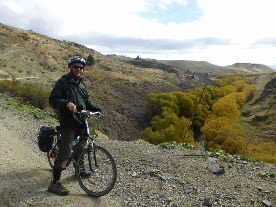 The second day of the bike ride starts colder and windier than the the first and
we wrap up well. The rail trail has revitalised the central Otago area and there's
not far between places for cyclists to eat or sleep. Our trail ends, after more viaducts
and tunnels, at Hyde. There is a small cafe there with no indication of what they
sell so you have to ask "Do you have soup?" and so on. What they did have is a NZ
speciality, cheese rolls. We had heard of these before we saw one and were a little
disappointed to discover that they are a stick of cheese wrapped in sliced bread
and then heated before serving. We saw some award winning cheese rolls where the
sliced brown bread had a secret ingredient spread on it before rolling that made
these rolls the best in the area. Our plan had been to head to Dunedin on the coast
after spending one more night in Clyde but after talking to some other cyclists we
decided to head to Oamaru instead.
The second day of the bike ride starts colder and windier than the the first and
we wrap up well. The rail trail has revitalised the central Otago area and there's
not far between places for cyclists to eat or sleep. Our trail ends, after more viaducts
and tunnels, at Hyde. There is a small cafe there with no indication of what they
sell so you have to ask "Do you have soup?" and so on. What they did have is a NZ
speciality, cheese rolls. We had heard of these before we saw one and were a little
disappointed to discover that they are a stick of cheese wrapped in sliced bread
and then heated before serving. We saw some award winning cheese rolls where the
sliced brown bread had a secret ingredient spread on it before rolling that made
these rolls the best in the area. Our plan had been to head to Dunedin on the coast
after spending one more night in Clyde but after talking to some other cyclists we
decided to head to Oamaru instead.
20th April -
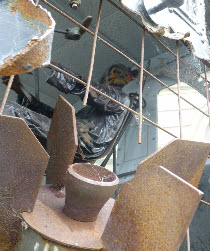 Oamaru, home of NZ's steampunk HQ. Steampunk is a type of science fiction which looks
to a future where technology has stalled in the Victorian era, a place of steam powered
spaceships piloted by skeletons made of scrap iron. The steampunk HQ on the quayside
has a punked steam locomotive outside that belches flames and smoke. We are both
quite taken with this and enthusiastically play with the art -
Oamaru, home of NZ's steampunk HQ. Steampunk is a type of science fiction which looks
to a future where technology has stalled in the Victorian era, a place of steam powered
spaceships piloted by skeletons made of scrap iron. The steampunk HQ on the quayside
has a punked steam locomotive outside that belches flames and smoke. We are both
quite taken with this and enthusiastically play with the art -
We visit another gallery (mainstream, THE most boring according to Phil) and then
test the local beer before heading off to Bushy Beach, a short drive away to see
the yellow eyed penguins come ashore between 4pm and 6pm -
On the way to Oamaru we stopped at Moeraki to see the spherical boulders there. The boulders are very like giant Maltesers, smooth on the outside with a honeycomb centre. They come in all sizes but it’s only the ones that are too big to fit on the back of a ute and take home for your garden that remain. There was some information that said they are concretions but it didn’t satisfactorily explain the honeycomb centre or the remarkable roundness.

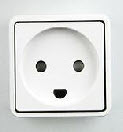
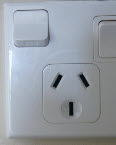 During our time in New Zealand and Australia we (Phil) couldn’t help but notice how
sad their mains sockets appear (left -
During our time in New Zealand and Australia we (Phil) couldn’t help but notice how
sad their mains sockets appear (left -
Compare and contrast with, for example, the much jollier Danish mains socket (right). Someone should start a campaign to cheer up antipodean sockets.
12th April -
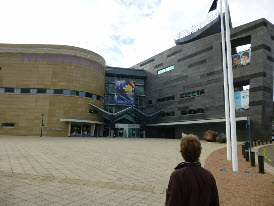 We had a couple of hours before the ferry set off for the South Island so we spent
the time looking around the Te Papa museum in Wellington. It’s a great place and
introduced us to the paintings of Rita Angus among others. We could easily have spent
days rather than hours there.
We had a couple of hours before the ferry set off for the South Island so we spent
the time looking around the Te Papa museum in Wellington. It’s a great place and
introduced us to the paintings of Rita Angus among others. We could easily have spent
days rather than hours there.
The ferry terminal was clearly signposted on the way in to Wellington and we assumed
it would be the same on the way out. Unfortunately there’s no obvious way of getting
to the ferry terminal from the city and we ended up driving 8 miles past it and then
8 miles back again, leaving us one of the last cars. We were put on the train deck
next to (surprise) some trains and had to reverse all of the way on to the ship.
Going upstairs (there must be a nautical term for this -
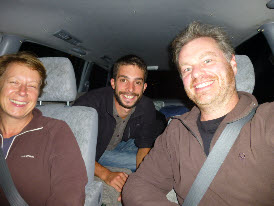 It’s overcast and very windy for the crossing, the wind giving the ferry a significant
list for most of the journey. This is a shame as this is reported to be one of the
most scenic ferry journeys in the world sailing through lots of islands and dramatic
views. Half way across we read how our ferry was a cut’n’shut, a 30m section had
been added to the middle 18 months ago, presumably by people who knew exactly what
they were doing?
It’s overcast and very windy for the crossing, the wind giving the ferry a significant
list for most of the journey. This is a shame as this is reported to be one of the
most scenic ferry journeys in the world sailing through lots of islands and dramatic
views. Half way across we read how our ferry was a cut’n’shut, a 30m section had
been added to the middle 18 months ago, presumably by people who knew exactly what
they were doing?
We are approached by a young French man while on the ferry asking if we’re going
to Nelson as he’s looking for a lift. We say we are but our fun-
Nelson is a small, arty town on the north coast of the South Island. We met a Kiwi cyclist in Luang Prabang who said he had done his research and that Nelson was the best place to live in the world based on things like climate, culture, sunshine hours and so on. When he heard we were going to NZ he said we should pop in to the Saturday market where he always has a stall (not, it turns out, on the Saturday we went).
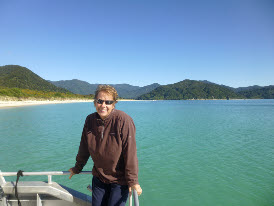 There’s something to be said for his choosing to live in Nelson and we both really
like the place by the time we leave. It is close to the Abel Tasman national park
and its coastal path, most easily accessed from boats that cruise up and down and
drop you off in the sandy bays along the coast. We have a great day for it and walk
a short section of the path. At the north end of the park there is a basic (really
basic) government campsite with 1000 pitches that is so popular over the Christmas
holidays that they have to draw lots to see who can stay.
There’s something to be said for his choosing to live in Nelson and we both really
like the place by the time we leave. It is close to the Abel Tasman national park
and its coastal path, most easily accessed from boats that cruise up and down and
drop you off in the sandy bays along the coast. We have a great day for it and walk
a short section of the path. At the north end of the park there is a basic (really
basic) government campsite with 1000 pitches that is so popular over the Christmas
holidays that they have to draw lots to see who can stay.
Nelson is full of good places to eat and we do our best to get round them all in
our time there. We also go to see King of the Gym, a play about old and new approaches
to teaching and how the non-