


19th November -
 Luang Prabang is at the confluence of the Nam Kahn and Mekong rivers (everywhere
we’ve been recently has been on the banks of the Mekong). Lots of people we have
met en-
Luang Prabang is at the confluence of the Nam Kahn and Mekong rivers (everywhere
we’ve been recently has been on the banks of the Mekong). Lots of people we have
met en-
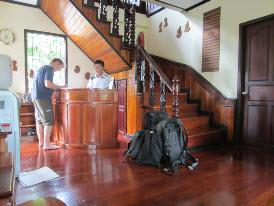
The guesthouse we are staying in is much nicer than the hotel in Vientiane. We are on the peninsula between the two rivers where most of the cafes and restaurants are. As in Vietnam and Cambodia, the French left their mark here with loads of French restaurants and French influenced food.
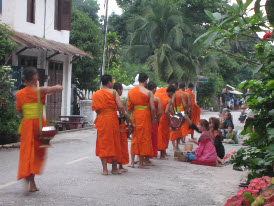 There is a tradition in Luang Prabang where, just after dawn, monks walk along the
street outside our guesthouse and receive alms (mostly food) from the locals. We
were getting up early for a boat trip one morning so we got up a bit earlier to see
the monks go by. The organisation of the boat trip was a bit chaotic. There are a
large number of boats and each boat takes only six tourists (there are seats for
more but perhaps six is as many as their insurance will stand). You are assigned
to a boat based on your ticket number but, because people come late or not at all,
you end up on whichever boat has room. Our first boat -
There is a tradition in Luang Prabang where, just after dawn, monks walk along the
street outside our guesthouse and receive alms (mostly food) from the locals. We
were getting up early for a boat trip one morning so we got up a bit earlier to see
the monks go by. The organisation of the boat trip was a bit chaotic. There are a
large number of boats and each boat takes only six tourists (there are seats for
more but perhaps six is as many as their insurance will stand). You are assigned
to a boat based on your ticket number but, because people come late or not at all,
you end up on whichever boat has room. Our first boat -
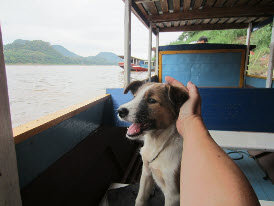 This second boat had clearly not expected to be going anywhere that day and we had
to stop at a floating petrol station for fuel. The trip up the river would have been
quite relaxing if any attempt had been made to make the car engine that powered the
boat even a little bit quieter. As it was we were all ready to get off when we got
to the ‘whisky village’. This provided an opportunity to buy the same souvenirs you
can buy in Luang Prabang town but in a village setting. They also sell purple rice
wine and various spirits, mostly with either a snake or a scorpion in the bottle.
Our final destination was the Pak Ou caves further upstream. We thought they would
be like the cave systems we had been to in Ha Long bay but they were much smaller
and had been turned into Buddhist shrines.
This second boat had clearly not expected to be going anywhere that day and we had
to stop at a floating petrol station for fuel. The trip up the river would have been
quite relaxing if any attempt had been made to make the car engine that powered the
boat even a little bit quieter. As it was we were all ready to get off when we got
to the ‘whisky village’. This provided an opportunity to buy the same souvenirs you
can buy in Luang Prabang town but in a village setting. They also sell purple rice
wine and various spirits, mostly with either a snake or a scorpion in the bottle.
Our final destination was the Pak Ou caves further upstream. We thought they would
be like the cave systems we had been to in Ha Long bay but they were much smaller
and had been turned into Buddhist shrines.
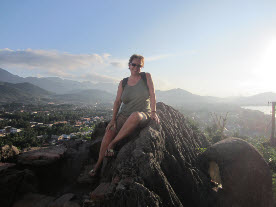 Karen had her best massage of the trip so far in an old French villa with whirring
ceiling fans. Afterwards she achieved her highest scrabble score ever -
Karen had her best massage of the trip so far in an old French villa with whirring
ceiling fans. Afterwards she achieved her highest scrabble score ever -
We’ve been aiming to see a film in every country and here we saw Total Recall (recent Colin Farrell version) in a small room over a bookshop. Not a bad action film, set in a future with megacities and flying cars*. Before the film, Karen had been to a yoga session at a nearby riverside bar. It was the proper hippy experience: in the open, all stars and candles. It must have been harder than the yoga she does at home as it left her unaccountably stiff the following day.
We’ve seen an evolution in tuktuk types as we’ve moved around southeast Asia. In
Cambodia the predominant type was a small motorbike (125cc or less) which had been
adapted to take a trailer. Most of these bikes had had rudimentary water-
*When will we all have flying cars? As a child of the 60’s and 70’s (moon landings;
Concorde; giant hovercraft; personal jetpacks; nuclear-
26th November -
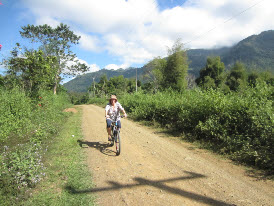 On Monday we hire some mountain bikes to go cycling in the hills. We have a vague
plan to cycle to one of the waterfalls but, on the way there, we see a sign with
two waterfalls on it: the left turn waterfall is 1km away, the right turn one (our
original choice) is 26km. The day is getting hot so we decide to have a look at the
closest one first. This waterfall is so small that we actually miss it completely
on the way up. We keep on going anyway, further and further into the hills. We pass
a sign for Belle Vue Resort which sounds like a decent place to stop for a drink
before we turn round and come back. Unfortunately the sign doesn't mention how far
the resort is. We reach it eventually, hours later. We thought the Belle Vue may
refer to a grand view over Luang Prabang but it is actually a view of the other side
of a valley. Still nice though, although if you stayed there you would probably be
getting a tuktuk into town most nights as there couldn't be less to do up there.
On Monday we hire some mountain bikes to go cycling in the hills. We have a vague
plan to cycle to one of the waterfalls but, on the way there, we see a sign with
two waterfalls on it: the left turn waterfall is 1km away, the right turn one (our
original choice) is 26km. The day is getting hot so we decide to have a look at the
closest one first. This waterfall is so small that we actually miss it completely
on the way up. We keep on going anyway, further and further into the hills. We pass
a sign for Belle Vue Resort which sounds like a decent place to stop for a drink
before we turn round and come back. Unfortunately the sign doesn't mention how far
the resort is. We reach it eventually, hours later. We thought the Belle Vue may
refer to a grand view over Luang Prabang but it is actually a view of the other side
of a valley. Still nice though, although if you stayed there you would probably be
getting a tuktuk into town most nights as there couldn't be less to do up there.
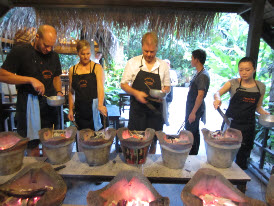 We book ourselves on to the Tamarind restaurant’s cookery school. It takes place
a few miles out of town at a place we passed the previous day on the bikes. The 10
others taking part in the course were a wide mix of ages and nationalities. The venue
is perfect with large pavilions over ornamental ponds with lots of exotic insects
around (Karen's bites attest to this). This was much more fun than we were expecting.
The teacher was Tamarind's number two chef, a charismatic 23 year old with a keen
sense of humour. We made aubergine and tomato dips and learned how to make sticky
rice (it cleverly sticks to itself but not to your fingers). Karen made fish marinated
in a paste, cooked in a banana leaf (anything cooked in a banana leaf is referred
to as mok). Phil did a similar tofu alternative. Karen, Ms. 'I like it spicy', consistently
made her dishes too hot. We also made tricky things inside lemongrass baskets (almost
impossible to make even if you had remembered your glasses). Ours were mixtures of
potato noodles and herbs while the others had chicken. We also made purple sticky
rice served with fruit as a pudding. The whole meal was really lovely and we were
sad to leave the table at the end. Not sure how much we will be able to recreate
when we get home even despite having the souvenir recipe book they gave us at the
end.
We book ourselves on to the Tamarind restaurant’s cookery school. It takes place
a few miles out of town at a place we passed the previous day on the bikes. The 10
others taking part in the course were a wide mix of ages and nationalities. The venue
is perfect with large pavilions over ornamental ponds with lots of exotic insects
around (Karen's bites attest to this). This was much more fun than we were expecting.
The teacher was Tamarind's number two chef, a charismatic 23 year old with a keen
sense of humour. We made aubergine and tomato dips and learned how to make sticky
rice (it cleverly sticks to itself but not to your fingers). Karen made fish marinated
in a paste, cooked in a banana leaf (anything cooked in a banana leaf is referred
to as mok). Phil did a similar tofu alternative. Karen, Ms. 'I like it spicy', consistently
made her dishes too hot. We also made tricky things inside lemongrass baskets (almost
impossible to make even if you had remembered your glasses). Ours were mixtures of
potato noodles and herbs while the others had chicken. We also made purple sticky
rice served with fruit as a pudding. The whole meal was really lovely and we were
sad to leave the table at the end. Not sure how much we will be able to recreate
when we get home even despite having the souvenir recipe book they gave us at the
end.
Feeling adventurous and fit we book a trekking/kayaking trip with an overnight stay
in a hill village. There are two main ethnic groups in the hill villages in northern
Laos. The Khmu who came from Cambodia and the Hmong who came from China. You can
recognise the village you are in by the buildings, Khmu build their houses on stilts
and Hmong build their houses on the ground, although in practice it's not quite as
clear-
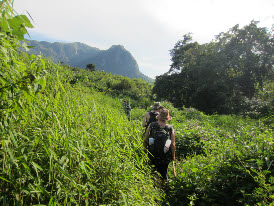 We are part of a group of six with Nick & Sara from the States and Dean & Olivia
from Switzerland (Dean originally from Kent). The trekking on the first day is hard
work, mostly uphill. We stop at two villages before we reach the homestay village.
At the first village, Olivia finds two leeches on her foot. There shouldn't be any
leeches around as it is the dry season but Olivia tells us that she is a leech-
We are part of a group of six with Nick & Sara from the States and Dean & Olivia
from Switzerland (Dean originally from Kent). The trekking on the first day is hard
work, mostly uphill. We stop at two villages before we reach the homestay village.
At the first village, Olivia finds two leeches on her foot. There shouldn't be any
leeches around as it is the dry season but Olivia tells us that she is a leech-
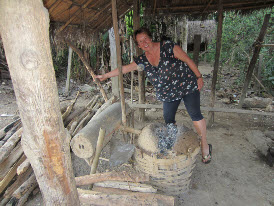
The village is quite big with about 400 people living there. There is a central meeting hall used whenever decisions have to be made with a large bell (the inner part of lorry's rear double wheel) used to summon everyone. The village has its own school, blacksmith (Karen helps by operating the bellows below), and a couple of small shops. Virtually all of the huts are made from completely renewable materials like teak, bamboo and palm leaves and the whole village has a very small environmental impact.
 There is a hut in the village dedicated to homestays. It has its own deluxe bathrooms
with two water tanks, one for flushing the toilet and the other with water for washing.
Both tanks have small fish in them that keep the water healthy (by eating mosquito
larvae if nothing else). It is very dark inside the bathrooms, even after your eyes
get used to the gloom, but they're not smelly and it is possible to have a kind of
shower in there if you are comfortable with pouring surprisingly cold water over
yourself. The village elder is paid by the trekking company and then decides where
to spend the money in the village (a new wide-
There is a hut in the village dedicated to homestays. It has its own deluxe bathrooms
with two water tanks, one for flushing the toilet and the other with water for washing.
Both tanks have small fish in them that keep the water healthy (by eating mosquito
larvae if nothing else). It is very dark inside the bathrooms, even after your eyes
get used to the gloom, but they're not smelly and it is possible to have a kind of
shower in there if you are comfortable with pouring surprisingly cold water over
yourself. The village elder is paid by the trekking company and then decides where
to spend the money in the village (a new wide-
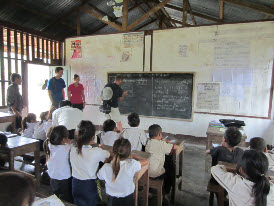 In the morning we stop at the school on the outskirts of the village. The children
all stand up and shout a greeting as each one of us comes in to the classroom. None
of us were expecting to stop there but Sara seems to have natural teacher-
In the morning we stop at the school on the outskirts of the village. The children
all stand up and shout a greeting as each one of us comes in to the classroom. None
of us were expecting to stop there but Sara seems to have natural teacher-
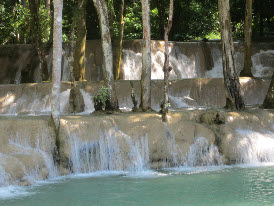 The second day involves a short trek to the Nam Kahn where we pick up the kayaks
to paddle down the river. On the way we pass some vandalized banana plants. It looks
like someone has pushed the middle part of the plant over for no obvious reason.
Around the corner we see giant footprints in some soft earth and, round the next
corner, fresh elephant poo. It looks like we were passing through less than an hour
after the elephant that had knocked over the banana plants -
The second day involves a short trek to the Nam Kahn where we pick up the kayaks
to paddle down the river. On the way we pass some vandalized banana plants. It looks
like someone has pushed the middle part of the plant over for no obvious reason.
Around the corner we see giant footprints in some soft earth and, round the next
corner, fresh elephant poo. It looks like we were passing through less than an hour
after the elephant that had knocked over the banana plants -
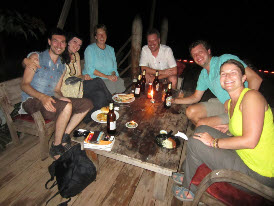 After such a good two days together we agree to meet up the night after next for
a drink at dusk. (Olivia thought dusk too dramatic a meeting time -
After such a good two days together we agree to meet up the night after next for
a drink at dusk. (Olivia thought dusk too dramatic a meeting time -
We set off one evening to a cafe next door to the place where Karen had her massage,
thinking that Phil could use the free wifi in the cafe while Karen had her second
ever pedicure next door. The plan works perfectly except the cafe has no wifi and
the pedicure place is all booked up. This only becomes obvious after Phil has ordered
a drink. We reconvene and take some time coming up with a new plan -
It’s the last day in Luang Prabang. We still haven’t been to the Kuang Si waterfall
despite being asked every day by tuktuk drivers. A very nice man (everyone is nice
here) asks us if we would like to go to the waterfall, this time we hesitate for
2.4 microseconds too long. He offers us a good deal -
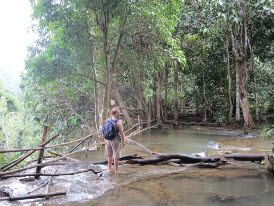 The waterfall is similar to Tad Sae but a lot higher and narrower. At the base there
is a small sanctuary for moon and sun bears. Our bear expertise led us to the sanctuary
with low expectations but, in fact, the bears were better cared for here than in
China. They have large pens with all of the toys we made for the Chinese moon bears
and a lot more. We walked to the top of the waterfall. Nick and Sara had told us
it was steep and high but we had naturally dismissed their opinion. In fact they
were exactly right. Karen started to walk across the top of the waterfall with only
a rickety fence to stop her plunging to her doom before Phil’s wailing brought her
to her senses and she returned.
The waterfall is similar to Tad Sae but a lot higher and narrower. At the base there
is a small sanctuary for moon and sun bears. Our bear expertise led us to the sanctuary
with low expectations but, in fact, the bears were better cared for here than in
China. They have large pens with all of the toys we made for the Chinese moon bears
and a lot more. We walked to the top of the waterfall. Nick and Sara had told us
it was steep and high but we had naturally dismissed their opinion. In fact they
were exactly right. Karen started to walk across the top of the waterfall with only
a rickety fence to stop her plunging to her doom before Phil’s wailing brought her
to her senses and she returned.
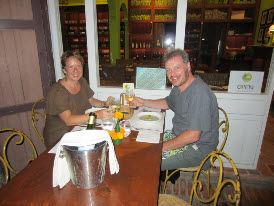 On the last evening we go L'Elephant Vert. It's Luang Prabang's premier (=only) posh
raw/organic/vegan restaurant with a single set menu (you'll have what you're given).
The food is unusual but very good. One thing we didn't realise before we went is
that, wherever possible, there are no carbohydrates in anything served. You only
need to look at us to realise that we are quite fond of our carbs. In the event we
don't miss them though as the food is all so new and tasty. Since you ask, Phil's
favourite was the Seasonal Lao Mushroom & Coriander Mousse and Karen's the Tomato
Carpaccio, Lime Zest & Vanilla Dressing.
On the last evening we go L'Elephant Vert. It's Luang Prabang's premier (=only) posh
raw/organic/vegan restaurant with a single set menu (you'll have what you're given).
The food is unusual but very good. One thing we didn't realise before we went is
that, wherever possible, there are no carbohydrates in anything served. You only
need to look at us to realise that we are quite fond of our carbs. In the event we
don't miss them though as the food is all so new and tasty. Since you ask, Phil's
favourite was the Seasonal Lao Mushroom & Coriander Mousse and Karen's the Tomato
Carpaccio, Lime Zest & Vanilla Dressing.
Luang Prabang has proved to be the perfect place for lolling around and doing nothing in particular. This was always very much part of the plan but this is the first place where we have actively pursued this course. Highly recommended.
Next: Thailand